Soybean exporters should review the evidence behind every country-of-origin declaration before accepting an India-bound order.
Reuters reported on 5 October 2026 that Indian customs is investigating soybean cargoes declared as originating in Niger, suspecting some came from Nigeria. Its report cites sources and customs correspondence it reviewed. This is an investigation into suspected misdeclarations, not a final finding against Nigerian exporters generally. The underlying notices have not been independently reviewed for this article.
Why origin deserves a separate check
The World Trade Organization explains that rules of origin determine a product's national source and can affect its tariff treatment. Governments use different criteria, so the rule applicable to the destination and preference scheme matters.
For a procurement team, the practical question is whether the claimed origin can be supported by records. The supplier's address, the invoicing company's location and the loading port answer different questions. Ask the importer to identify the exact origin rule being used rather than treating any one of those details as sufficient evidence.
India's Ministry of Finance explained in September 2020 that its CAROTAR framework requires due diligence for preferential imports under trade agreements. That historical release gives useful context, but it does not establish which procedure applies to a particular soybean consignment or unilateral preference. Ask the importer or customs adviser to confirm the current scheme, notification and documentation for the proposed order.
Build an origin file before dispatch
Our advice is to keep a shipment file that connects the beans to their sourcing records. Include supplier identities, collection locations, purchase receipts, lot numbers, warehouse movements and dispatch documents. Record how a consolidated lot was assembled and which quantities came from each supplier.
For an aggregator, this starts when the crop is purchased. A neat export file cannot replace missing collection records. Ask suppliers to provide the evidence they actually hold, and investigate gaps before issuing documents or accepting the buyer's proposed origin statement.
Keep transport information consistent with the sourcing history. Where goods move across borders or through a transit country, retain the relevant transport and transit records. Ask the customs adviser what additional evidence is needed for that route. Avoid assuming that routing alone settles origin.
Review the commercial documents together
Compare the origin declaration, certificate, invoice, packing list and transport documents before loading. Check country names, lot identifiers, quantities, dates and supplier details. Correct an inconsistency through the proper issuing process rather than changing a document informally.
Agree who prepares each document and who checks it. The buyer should confirm that the required certificate format and issuing authority are acceptable under the applicable scheme. Keep the basis for any preferential-duty claim in writing.
Origin evidence also needs to be kept separate from quality evidence. A laboratory result may describe the tested sample's characteristics, but the shipment still needs its own sourcing and movement records. Organise both files so the importer can answer different questions without mixing the documents.
Clarify the cost of an unresolved claim
Before agreeing a delivered price, ask the importer to confirm the applicable duty treatment. This article does not quote a current Indian tariff, Nigerian soybean price or freight rate. Obtain those figures for the actual product, origin, date and route.
The commercial risk to consider is a cost calculation that relies on a preference the parties cannot support. Ask who carries additional duty, storage and delay costs when an origin claim is challenged. Agree how payment and delivery deadlines will be handled during a document query.
For a new enquiry, provide the product, quantity, sourcing location, destination and required delivery date. You can contact Artesana to discuss agricultural sourcing requirements. Confirm availability and the documentation needed for the proposed transaction directly.
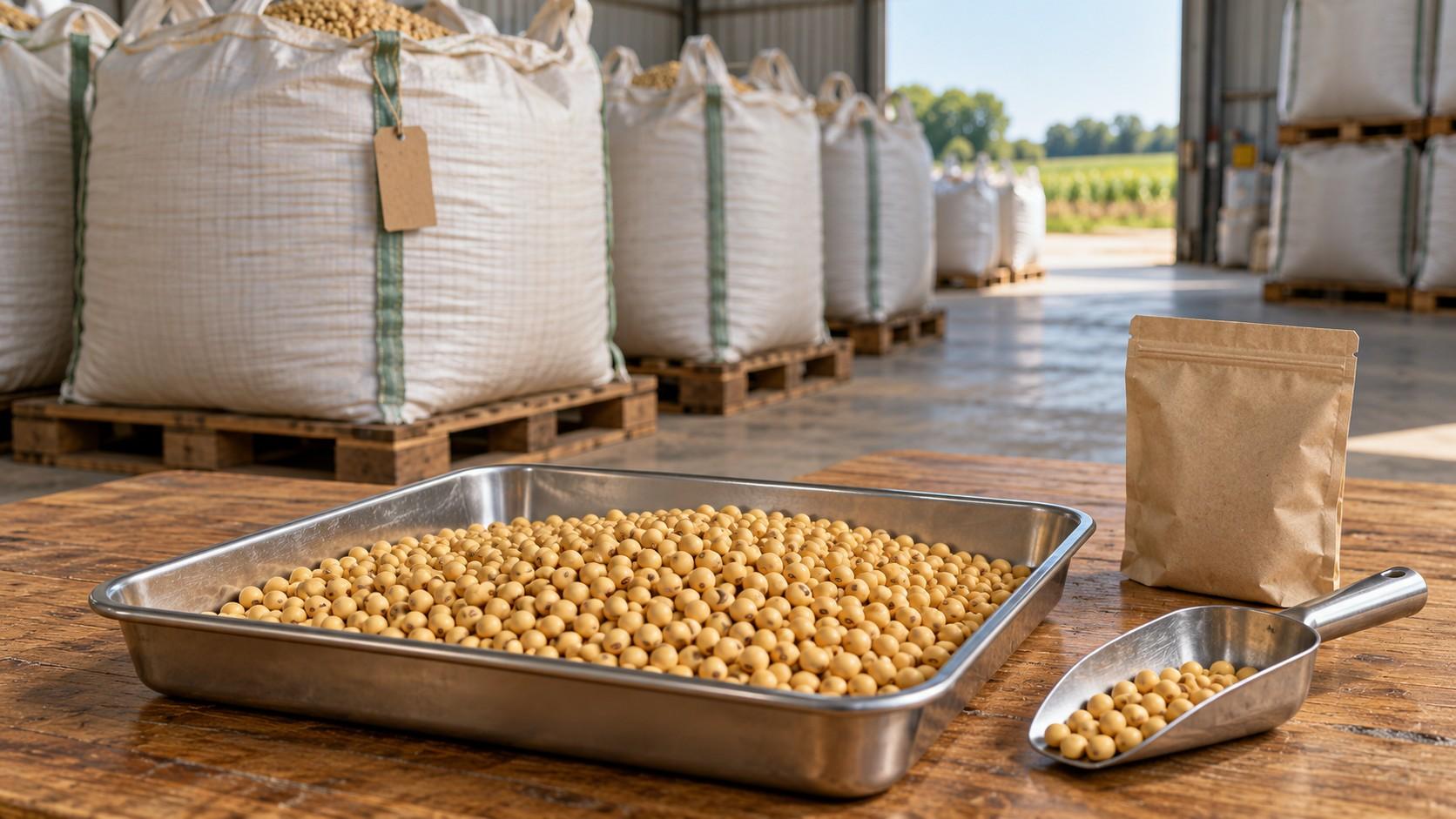
Featured image: AI-generated illustration of soybean sampling and packed sacks; not a photograph of a shipment under investigation.
Discuss your sourcing requirements
Review Artesana’s soya beans product page and share your quantity, destination and buyer specification when requesting a quote. Availability, testing, packaging and delivery terms need to be confirmed for the particular order.
Sources
- Reuters, soybean origin investigation, published 5 October 2026: report.
- WTO, Technical Information on Rules of Origin, undated, accessed 6 October 2026: official background.
- India's Ministry of Finance via PIB, CAROTAR implementation announcement, published 18 September 2020; framework introduced from 21 September 2020: historical official release.
 Artesana Editorial Team
Practical insights into agricultural sourcing, product quality and international trade.