Gum Arabic is one of those natural products that can move through several industries before it reaches the final consumer.
The same raw gum collected from Acacia trees can eventually be used in food and beverages, confectionery, pharmaceutical formulations, cosmetics, printing, art materials and other industrial applications.
For a bulk buyer, however, the name alone is not enough.
Botanical source, cleanliness, moisture, colour, grade, microbiological quality and the level of processing can all affect whether a particular batch is suitable for its intended use.
This guide explains what Gum Arabic is, how it is used, what research says about its potential benefits, and what buyers should check when sourcing Nigerian Gum Arabic.
What Is Gum Arabic?
Gum Arabic, also known as Arabic gum or acacia gum, is a natural dried exudate obtained from certain Acacia trees.
FAO/WHO JECFA defines it as the dried exudate obtained from the stems and branches of Acacia senegal or Acacia seyal.
Chemically, it is made mainly of complex polysaccharides and their mineral salts.
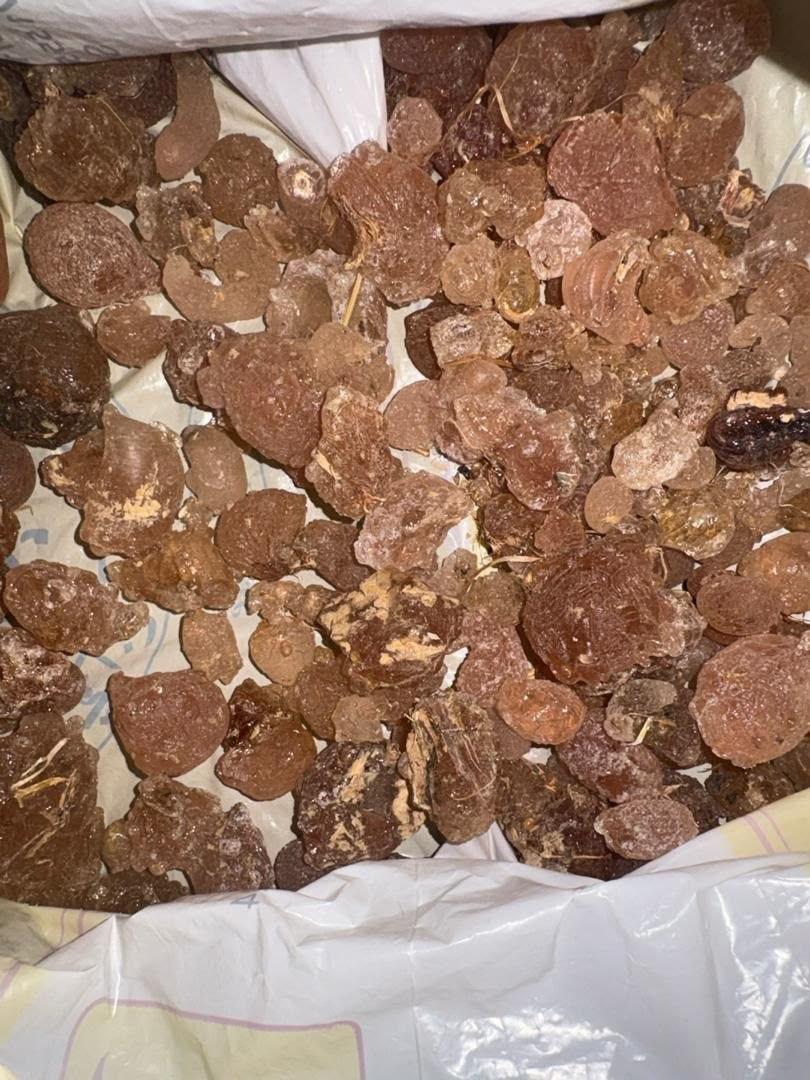
When the gum is first collected and dried, it appears as solid pieces or tears that can range in colour from pale or whitish shades to amber and brown.
It can later be cleaned, sorted, crushed, granulated or processed into powder depending on the buyer's requirements.
Is Gum Arabic the Same as Acacia Gum?
Yes.
Gum Arabic, Arabic gum and acacia gum are commonly used names for the same material.
The World Health Organization's JECFA database lists Gum Arabic, Acacia Gum and Arabic gum as synonyms and identifies the food additive as INS 414.
However, botanical source still matters.
Commercial Gum Arabic is principally associated with Acacia senegal and Acacia seyal. These gums can differ in physical and functional characteristics, which is why a technical buyer may ask the supplier to confirm the species or grade before purchase.
How Is Gum Arabic Produced?
Gum Arabic forms as an exudate on Acacia trees.
The gum is collected after it has hardened and dried naturally. Depending on the production system, exudation may occur naturally or following controlled tapping of the tree.
After collection, raw gum can contain natural variation in colour, shape and size.
It may also require further cleaning and sorting before being used in food or high-specification industrial applications.
The FAO/WHO specification specifically notes that commercial material can contain extraneous matter such as pieces of bark or sand that must be removed before food use.
This is one reason why buyers should distinguish between raw Gum Arabic and fully processed food-grade Gum Arabic.
What Is Gum Arabic Used For?
One of the reasons Gum Arabic remains commercially important is its versatility.
Food and Beverage Production
Gum Arabic is widely used as a food additive.
The Codex General Standard for Food Additives identifies Gum Arabic, or Acacia Gum, as INS 414 and recognises functions including:
- Emulsifier
- Stabilizer
- Thickener
- Carrier
- Bulking agent
- Glazing agent
These properties make it useful in a wide range of food and beverage formulations.
For example, an emulsifier can help ingredients that would normally separate remain dispersed within a product. A stabilizer can help maintain consistency during storage, while a carrier can help deliver flavours or other ingredients within a formulation.
The exact grade and processing level required will depend on the final product.
Confectionery
Gum Arabic has a long history of use in confectionery.
Its film-forming and binding properties can be useful in coatings and other confectionery applications.
Food manufacturers should still work from a defined food-grade specification rather than assuming that raw gum is ready for direct use.
Pharmaceutical and Cosmetic Applications
Gum Arabic has also been used in pharmaceutical and cosmetic formulations.
Its ability to dissolve or disperse in water and contribute to texture, stability and binding makes it useful in certain formulations.
The requirements for pharmaceutical or cosmetic use can be stricter than those for general industrial use, so buyers should specify the intended application and required standards before sourcing.
Watercolour, Ink and Printing
Gum Arabic also has applications outside food.
It is traditionally used as a binder in watercolour paint and has been used in inks, printing and lithographic processes.
This is why Gum Arabic can be relevant to both food manufacturers and art-material producers.
The raw material may be the same general natural gum, but the purity, processing, colour and formulation requirements can be very different.
Gum Arabic Powder vs Raw Gum Arabic Pieces
Gum Arabic is sold in several forms.
FAO/WHO specifications recognise commercial forms including whole pieces, flakes, granules, powder and spray-dried material.
Raw Pieces
Raw or minimally processed Gum Arabic is normally supplied as dried pieces.
This form can be suitable for buyers who have their own cleaning, sorting, crushing, milling or further-processing systems.
Gum Arabic Powder
Gum Arabic powder has already undergone additional processing.
Depending on the application, a buyer may require a specific particle size, microbiological standard, solubility profile, colour or functional performance.
Powder should therefore not be treated as simply the same product in smaller pieces.
The processing method and quality specification matter.
Artesana's current Nigerian Gum Arabic product is supplied as raw, dried pieces for buyers who may require further cleaning, sorting, crushing or industrial processing.
What Are the Potential Benefits of Gum Arabic?
Gum Arabic has attracted scientific interest because it behaves as a soluble, fermentable dietary fibre.
A systematic review of human clinical trials published in 2023 examined research into Gum Arabic across several health areas. The authors reported potentially beneficial findings in areas including gastrointestinal health and metabolic markers, but they also highlighted limitations in the available evidence and the need for larger and longer-term research.
Research has also examined the prebiotic properties of Gum Arabic, including its interaction with bacteria in the human digestive system.
These findings are interesting for food and nutrition applications, but Gum Arabic should not be marketed as a guaranteed treatment for disease.
A buyer developing a food, supplement or health-related product should follow the food, labelling and health-claim regulations that apply in the destination market.
What Determines Gum Arabic Quality?
For bulk purchasing, quality should be defined by measurable requirements rather than appearance alone.
1. Botanical Source
The buyer may need to know whether the material comes from Acacia senegal, Acacia seyal or a specified commercial grade.
The two recognised sources can have different physical and functional characteristics.
2. Purity and Foreign Matter
Raw Gum Arabic can contain natural foreign materials from collection and handling.
These can include bark, sand, dust or other plant material.
A buyer should define the acceptable purity and admixture levels before purchase.
3. Moisture
Moisture can affect storage stability, weight and processing.
The required moisture limit may depend on whether the gum is being purchased as raw pieces, granules or processed powder.
A commercial buyer should state the exact specification required for the transaction.
4. Colour and Grade
Gum Arabic can naturally vary in colour from pale or white shades through amber to brown.
Colour can be important for applications where the finished product needs to remain light or transparent.
A buyer should therefore specify whether colour or visual grade is important.
5. Solubility and Functional Performance
For manufacturers, Gum Arabic is often purchased because of what it does in a formulation.
Depending on the application, buyers may test:
- Solubility
- Viscosity
- Emulsification performance
- Stability
- Particle size
- Colour
- pH
- Functional consistency between batches
A visual inspection alone cannot confirm all of these properties.
6. Microbiological and Contaminant Limits
Food and pharmaceutical buyers may require microbiological testing and contaminant limits.
The FAO/WHO JECFA specification includes criteria relating to Salmonella, E. coli, ash, acid-insoluble matter and lead for Gum Arabic intended to meet its food-additive specification.
The buyer should provide the exact laboratory and regulatory limits required for the intended market.
Nigerian Gum Arabic
Nigeria has a long history of Gum Arabic production, particularly in the northern part of the country where Acacia species are found.
The Nigerian Export Promotion Council continues to identify Gum Arabic as an agricultural commodity with export-development potential.
In 2024, NEPC reported discussions with Jigawa State that included plans to develop processing capacity for Gum Arabic alongside other export commodities.
For international buyers, Nigeria can therefore represent a source of raw Gum Arabic for further processing, manufacturing and distribution.
The important issue is matching the actual batch to the buyer's required specification.
Exporting Gum Arabic From Nigeria
Formal agricultural exports from Nigeria require documentation and regulatory compliance.
The Nigerian Export Promotion Council states that exporters must register with NEPC and that formal exports require documents at different stages of the transaction.
Depending on the shipment, these can include:
- Exporter's Certificate
- Export contract
- Commercial invoice
- Packing list
- Nigeria Export Proceeds Form
- Certificate of Origin
- Applicable quality and inspection documents
Agricultural products can also fall under Nigeria Agricultural Quarantine Service inspection and certification requirements.
NAQS states that plant and plant products intended for export or export processing must undergo applicable quarantine inspection and certification.
Importing countries may impose additional requirements.
This is why the destination market should be known before the shipment is prepared.
What Should Bulk Buyers Ask Before Ordering Gum Arabic?
Before confirming a large purchase, a buyer should provide a specification rather than requesting Gum Arabic by name alone.
Useful requirements can include:
- Intended use
- Botanical source, if required
- Raw pieces, granules or powder
- Grade
- Colour
- Purity
- Maximum admixture
- Moisture
- Particle or piece size
- Microbiological limits
- Heavy-metal limits
- Packaging
- Quantity
- Destination
- Incoterm
- Required laboratory tests
- Required certifications or regulatory documents
Not every transaction needs every parameter.
But the more technical the final application is, the more important the specification becomes.
Sourcing Nigerian Gum Arabic From Artesana
Artesana supplies natural Nigerian Gum Arabic in raw, dried pieces.
Our current Nigerian Gum Arabic product is listed as Nigerian in origin, naturally cultivated, supplied in pieces, and available in brown and white-piece grades.
The product page currently lists 99% purity, while moisture and other technical parameters can be confirmed through inspection or laboratory testing before bulk shipment.
Because this is a raw and minimally processed natural product, individual pieces can vary in shape, size, texture and shade.
Artesana can work with buyer requirements for sorting, grading, packaging, quantity and quality specifications.
If you are sourcing Gum Arabic for food manufacturing, beverages, confectionery, pharmaceutical processing, cosmetics, art materials or another industrial application, tell us what the gum will be used for and provide your required specification.
Visit the Artesana Nigerian Gum Arabic product page to review the product and request a quote.
Sources
- FAO/WHO JECFA: Gum Arabic Specification
- Codex General Standard for Food Additives: Gum Arabic
- World Health Organization JECFA: Acacia Gum
- National Library of Medicine: Systematic Review of Gum Arabic Clinical Trials
- PubMed: Gum Arabic and Prebiotic Function
- Nigerian Export Promotion Council: Export Documents and Procedures
- Nigeria Agricultural Quarantine Service: Export Requirements
- Artesana: Nigerian Gum Arabic
 Artesana Editorial Team
Practical insights on agricultural products, sourcing, quality and international trade from Artesana.