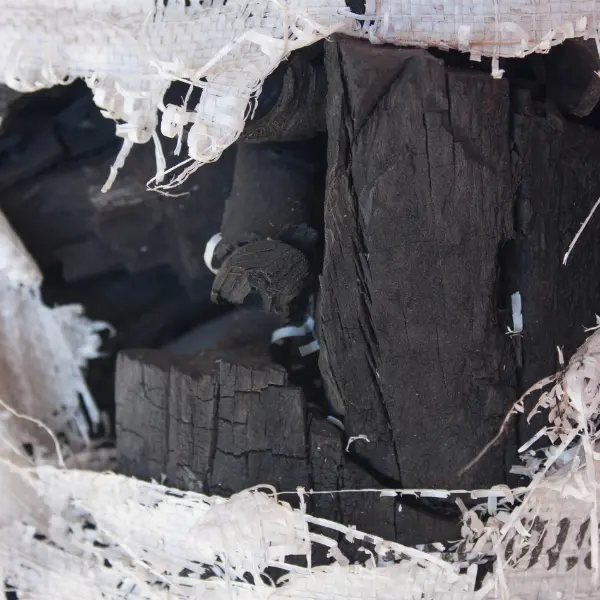
Charcoal is used every day for grilling, commercial cooking, heating and several industrial applications. But when you are buying charcoal in bulk, simply knowing that it is black and burns is not enough.
Moisture, ash, fixed carbon, size, raw material and the amount of broken charcoal in a shipment can all affect its performance and commercial value.
For buyers considering Nigerian charcoal, understanding these factors can make it easier to compare suppliers and agree on the right specification before placing an order.
What Is Charcoal?
Charcoal is a carbon-rich material produced when wood or other biomass is heated with a limited supply of oxygen.
This process is known as carbonisation.
Instead of allowing the wood to burn completely into ash, carbonisation removes much of its moisture and volatile material while leaving behind a solid material containing a high proportion of carbon.
The Food and Agriculture Organization of the United Nations explains that the properties of charcoal depend on factors including the original wood, carbonisation process, temperature, moisture and handling.
The result is a fuel that can produce strong heat while weighing considerably less than the original wood.
What Is Charcoal Used For?
One of the most familiar charcoal uses is cooking.
Lumpwood charcoal is commonly used for:
- Barbecue and grilling
- Restaurants and commercial kitchens
- Outdoor cooking
- Smoking food
- Household cooking in suitable outdoor or properly designed cooking environments
Charcoal also has industrial applications.
The FAO notes that charcoal has historically been used for cooking and grilling as well as metal production and other industrial processes.
Different applications can require different charcoal specifications.
A restaurant purchasing charcoal for grilling may care about ignition, burn time, heat consistency, smoke and piece size.
An industrial buyer may place greater emphasis on fixed carbon, ash, moisture, strength and chemical composition.
This is why buyers should define the intended use before agreeing on quality specifications.
Lumpwood Charcoal vs Charcoal Briquettes
Lumpwood charcoal and charcoal briquettes are both widely used as fuel, but they are different products with different characteristics.
Lumpwood charcoal
Lumpwood charcoal is produced by carbonising pieces of wood.
It normally retains an irregular natural shape because the pieces have not been ground and compressed into a manufactured form.
The size and density can vary depending on the wood and production process.
Charcoal briquettes
Charcoal briquettes are manufactured products.
According to the FAO's guidance on charcoal briquetting, charcoal fines can be ground and combined with a binder before being compressed into a consistent shape and dried.
This gives briquettes greater uniformity in size and shape.
Neither format automatically means better quality.
The right choice depends on what the buyer intends to do with the charcoal and the specifications required.
Artesana's current Nigerian Charcoal product is supplied in whole form and is described as being produced from selected hardwoods.
What Determines Charcoal Quality?
For a commercial buyer, charcoal quality should be measured using specifications rather than appearance alone.
Some of the most important factors include the following.
1. Moisture content
Moisture affects the usable energy in charcoal because part of the heat produced during burning has to evaporate the water.
The FAO explains that properly burned charcoal can absorb moisture from the surrounding air during storage and handling.
This makes moisture testing particularly important when charcoal is purchased by weight.
A buyer should therefore state the acceptable moisture range in the specification.
2. Fixed carbon
Fixed carbon is one of the major indicators used when evaluating charcoal.
In simple terms, it represents the carbon remaining after moisture, volatile matter and ash are accounted for.
Higher fixed carbon can be particularly important for buyers who require strong, sustained heat or use charcoal in industrial processes.
But the required percentage should depend on the application rather than assuming that one value is suitable for every buyer.
3. Ash content
Ash is the non-combustible material left after the charcoal has burned.
The amount of ash can be influenced by the original wood, bark and contamination during production and handling.
FAO guidance notes that good-quality lump charcoal can have relatively low ash content, while fines contaminated with soil and other materials may contain considerably more ash.
For buyers, excessive ash can mean less usable fuel and more residue after burning.
4. Volatile matter
Volatile matter affects how charcoal ignites and burns.
Charcoal with higher volatile matter can be easier to ignite but may produce more visible flame or smoke.
Charcoal with lower volatile matter can burn more cleanly but may be harder to start.
This is another reason why specifications should match the final application.
5. Piece size
Size matters, particularly for restaurants, BBQ distributors and industrial buyers.
Very small pieces can restrict airflow or behave differently during burning.
Large pieces may provide longer burning characteristics but may not suit every grill or furnace.
A commercial order can therefore specify an acceptable size range.
6. Fines and breakage
Charcoal is brittle.
Transportation and repeated handling can cause pieces to break into smaller fragments and charcoal dust known as fines.
The FAO identifies friability and breakage as important factors in charcoal transport and distribution.
Bulk buyers should therefore consider acceptable fines percentage, packaging and how the product will be handled before delivery.
Does Hardwood Matter?
The type of wood used to produce charcoal can influence density, strength and combustion characteristics.
FAO guidance notes that hardwoods generally produce denser charcoal, while softer woods can produce lighter and more friable charcoal.
However, the source material is only part of the final quality.
Carbonisation temperature, production method, storage and handling also matter.
A hardwood source alone does not remove the need for laboratory testing or an agreed commercial specification.
Artesana describes its Nigerian Charcoal as being made from selected hardwoods.
What Should Bulk Charcoal Buyers Check?
A buyer requesting several metric tons of charcoal should be more specific than simply asking for "good charcoal."
Depending on the intended application, the specification may include:
- Charcoal type
- Wood source or species requirements
- Piece size
- Moisture content
- Fixed carbon
- Ash content
- Volatile matter
- Calorific value
- Fines percentage
- Packaging
- Quantity
- Loading requirements
- Destination
- Incoterm
- Required laboratory analysis
- Sustainability and sourcing documentation
Not every order will require every parameter.
The important thing is to agree on what matters before production, packing and shipment.
A restaurant distributor, industrial processor and retail BBQ brand may all require completely different charcoal specifications.
Nigerian Charcoal and Export Requirements
Charcoal requires particular attention when discussing exports from Nigeria because its production and trade are connected to forestry and environmental regulation.
Nigeria has National Environmental (Control of Charcoal Production and Export) Regulations specifically covering charcoal production, handling and export.
The regulations are intended to control tree felling, protect ecosystems and regulate the commercial charcoal trade.
The National Environmental Standards and Regulations Enforcement Agency lists these regulations among Nigeria's environmental laws.
The regulations also provide for permits relating to commercial charcoal production, handling, transportation and export.
They restrict the use of endangered, threatened and prohibited plant species and require charcoal intended for export to follow the applicable approval and permit process.
You can review the Control of Charcoal Production and Export Regulations for the regulatory framework.
This means responsible sourcing is particularly important for charcoal.
Buyers and exporters should verify the source of the charcoal and confirm the latest applicable permits and regulatory requirements before shipment.
Formal Export Documentation
Charcoal exporters also have to consider Nigeria's general formal export procedures.
The Nigerian Export Promotion Council states that export documentation is required for formal exports from Nigeria.
Depending on the transaction, documentation can include:
- NEPC Exporter's Certificate
- Form NXP
- Commercial invoice
- Packing list
- Certificate of Origin
- Bill of Lading or other transport document
- Applicable permits and certificates
Charcoal may require additional environmental or forestry approvals because of the regulations governing its production and export.
Importing countries can also impose their own requirements.
Buyers and exporters should therefore confirm the requirements for the specific destination rather than relying on a general export checklist.
Safe Use of Charcoal
Charcoal should always be used with proper ventilation and should never be burned inside an enclosed space.
Burning charcoal produces carbon monoxide, a colourless and odourless gas that can cause serious poisoning or death.
The U.S. Centers for Disease Control and Prevention specifically advises that charcoal should never be burned indoors.
For grilling and household cooking, charcoal-burning equipment should be used outdoors or in an environment specifically designed with adequate ventilation for that purpose.
Sourcing Nigerian Charcoal From Artesana
Artesana supplies Nigerian charcoal for buyers requiring bulk quantities.
Our current Nigerian Charcoal product is listed as black, whole-form charcoal of Nigerian origin and is described as being produced from selected hardwoods.
If you are sourcing charcoal for BBQ distribution, restaurants, commercial cooking, industrial use or another application, provide your exact requirements when requesting a quote.
Useful information includes:
- Required quantity
- Destination country
- Intended use
- Preferred piece size
- Maximum moisture
- Fixed carbon requirement
- Maximum ash
- Fines tolerance
- Packaging requirements
- Required certifications or laboratory tests
- Delivery terms
A detailed specification makes it easier to determine whether the available charcoal matches what your business actually needs.
Visit the Artesana Nigerian Charcoal product page to review the product and request a quote.
Sources
 Artesana Editorial Team
Practical insights on agricultural products, sourcing, quality and international trade from Artesana.