Nigerian cocoa exporters supplying Europe should test their traceability records before the EU Deforestation Regulation begins to apply on 30 December 2026. Waiting until a container is ready could leave too little time to fix missing farm coordinates or mixed lots.
The European Commission's current implementation page says the rule covers cocoa, soy, rubber, oil palm and several other commodities and derived products. Covered goods placed on or sold within the EU must be deforestation-free and produced in line with the laws of the country of production.
Check the product and buyer role first
The regulation places the main obligation on the operator that first puts a covered product on the EU market. A Nigerian supplier that does not place goods on the EU market may not be that operator, but the EU buyer can still require farm locations, production dates and supporting records.
Ask the importer to confirm the exact Combined Nomenclature code and whether the product appears in Annex I. Cocoa beans under code 1801 are listed, along with cocoa paste, butter, powder, chocolate and other covered products. Product form matters, so do not assume one answer covers every cocoa item.
The contract should name the EU operator, the party submitting the due diligence statement and the records the Nigerian exporter must provide. Confirm when the buyer will approve the file and whether a due diligence reference number must be available before customs clearance.
Build records from plot to export lot
The consolidated regulation requires the geolocation of all plots that produced the commodity, together with the production date or time range. Coordinates need at least six decimal digits. A production plot larger than four hectares must be described with a polygon.
The goods must also be linked to land that was not deforested after 31 December 2020. The EU operator still has to assess the evidence and decide whether the risk is negligible. A farm certificate or third-party scheme may support that assessment, but it does not replace the operator's responsibility.
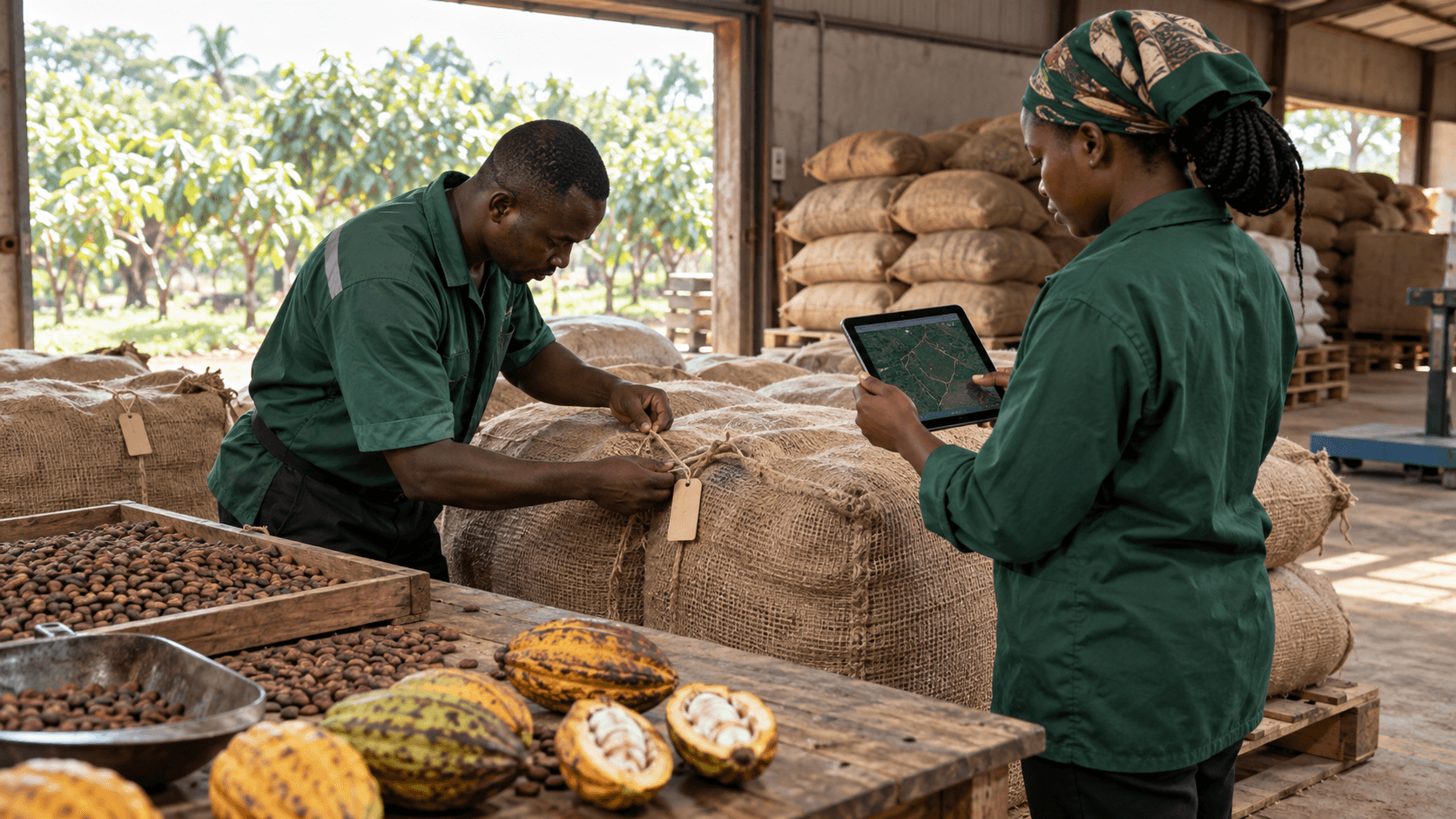
For each supplier, keep the farmer identity, plot identifier, coordinates, production period, purchase record and quantity. Connect those records to the warehouse intake, bag or bulk-lot identifier, processing record, packing list and container documents. The quantities should reconcile from purchase to shipment.
Keep unknown-origin cocoa out of mapped lots
Mixing mapped beans with cocoa from an unknown plot can weaken the evidence for the full lot. Set a clear intake rule, mark storage areas and record every transfer or consolidation. Staff should know which identifier follows the beans when bags are opened, combined, cleaned or repacked.
Reuters reported on 17 August 2026 that Nigerian exporters were spending money on farm mapping and traceability while industry experts expected a large share of the country's cocoa to face initial compliance problems. A Reuters report published on 8 October shows the same plot-level challenge in natural rubber supply chains dominated by smallholders.
These reports describe preparation risks, not a guarantee of a price premium or rejection. The result for a particular shipment depends on its evidence, buyer and product code.
Agree costs and failure points
Put mapping, verification, data correction and audit costs into the quotation. State the currency, unit, date and delivery basis for any commercial charge. Agree who pays when a file is incomplete, the buyer requests more evidence, or a lot must be held or replaced.
Before dispatch, send the buyer a test file for one lot. Ask for written confirmation that the format, coordinates, production dates and chain-of-custody records are usable. Keep quality specifications, laboratory results and phytosanitary documents in the shipment file too, because deforestation evidence does not replace normal product and border requirements.
For a cocoa sourcing or export enquiry, contact Artesana with the product form, quantity, origin, destination and required documents.
Sources
- European Commission, Implementing the EU Deforestation Regulation, current guidance accessed 10 October 2026; application date 30 December 2026: official guidance.
- EUR-Lex, Regulation (EU) 2023/1115, adopted 31 May 2023; consolidated text accessed 10 October 2026: official legal text.
- Reuters, West Africa cocoa sector struggles to meet EU anti-deforestation rules, published 17 August 2026: Nigeria and regional report.
- Reuters, Sticky situation: Tyre industry struggles to clean up its rubber supply chain, published 8 October 2026: smallholder traceability report.